Roth IRA vs Traditional IRA: Which One Should You Choose in 2026?
Compare Roth IRA vs Traditional IRA with real numbers, tax calculations, and clear recommendations based on your age, income, and goals. 2026 contribution limits included.
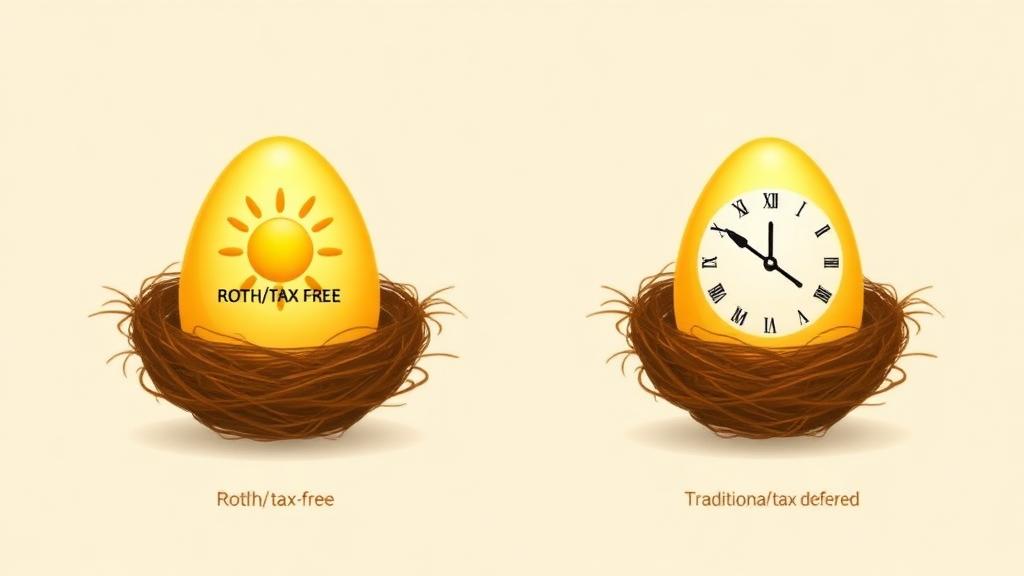
Roth IRA vs Traditional IRA: Which One Should You Choose in 2026?
When I opened my first IRA at 24, I spent three weeks paralyzed by this decision. Roth or Traditional? Pay taxes now or later? I read forum posts, watched YouTube videos, ran calculators — and still felt confused.
Here’s what I wish someone had told me: for about 80% of people under 40, the Roth IRA is the better choice. But “most people” isn’t everyone, and the details matter more than the generalization.
After years of investing in both accounts (and running the numbers obsessively), I’m going to break this down in a way that actually makes sense. By the end of this article, you’ll know exactly which account is right for your specific situation — no more analysis paralysis.
The Core Difference (In Plain English)
Traditional IRA: You get a tax break TODAY. Your contributions may be tax-deductible (reducing this year’s tax bill). But you’ll pay income tax on everything when you withdraw in retirement.
Roth IRA: You pay taxes TODAY. No deduction now. But every dollar you withdraw in retirement — including all the growth — is completely tax-free.
Think of it like a farmer: would you rather pay tax on the seed (small amount now) or the harvest (much larger amount later)?
Pro Tip: The Roth IRA lets you pay tax on a small amount today to avoid tax on a potentially enormous amount in the future. If you’re young and in a lower tax bracket now, this is almost always the right move.
2026 IRA Rules at a Glance
| Feature | Roth IRA (2026) | Traditional IRA (2026) |
|---|---|---|
| Contribution Limit | $7,000 ($8,000 if 50+) | $7,000 ($8,000 if 50+) |
| Tax Benefit | Tax-free withdrawals in retirement | Tax deduction today (if eligible) |
| Income Limit (Single) | Phase-out: $150,000-$165,000 | No income limit to contribute (deduction phases out) |
| Income Limit (Married) | Phase-out: $236,000-$246,000 | No income limit to contribute |
| Required Minimum Distributions | None (lifetime) | Must start at age 73 |
| Early Withdrawal (contributions) | Anytime, penalty-free | 10% penalty + taxes before 59½ |
| Early Withdrawal (earnings) | 10% penalty + taxes before 59½ | 10% penalty + taxes before 59½ |
| Best For | Younger/lower income earners | Higher income earners near peak |
The Real Math: Roth vs Traditional Over 30 Years
Let’s say you’re 30 years old, earn $65,000/year, and can invest $500/month into either account. Here’s what happens over 30 years (assuming 8% average annual return):
Scenario: $500/month for 30 years at 8% return
Roth IRA Path:
- Monthly contribution: $500 (after-tax dollars)
- Total contributed over 30 years: $180,000
- Account value at 60: $745,180
- Tax owed on withdrawal: $0
- Money in your pocket: $745,180
Traditional IRA Path:
- Monthly contribution: $500 (pre-tax dollars)
- Tax savings reinvested: $110/month (22% bracket)
- Total contributed over 30 years: $180,000 + $39,600 reinvested tax savings
- Account value at 60: $745,180 (same growth)
- Tax owed on withdrawal (assume 22% bracket): $163,940
- Money in your pocket: $581,240
- Reinvested tax savings grown at 8%: $163,738 (taxable account)
- True total: $744,978
Result: Nearly identical IF your tax rate stays the same.
But here’s the thing — tax rates rarely stay the same. And that’s where the decision gets interesting.
When the Roth IRA Wins (Clearly)
1. You’re Under 35 and Not at Peak Earnings
If you’re early in your career, you’re likely in a lower tax bracket now than you will be later. Paying 12-22% tax on contributions now to avoid 24-32% tax on withdrawals later is a great trade.
2. You Think Tax Rates Will Rise
With national debt exceeding $36 trillion and historic tax rates much higher than today, many financial experts believe rates will increase. The Roth locks in today’s lower rates.
3. You Want Flexibility
Roth IRA contributions (not earnings) can be withdrawn anytime, penalty-free. This makes it double as an emergency backup — though I’d recommend keeping a separate emergency fund for that purpose.
4. You Want to Leave Money to Heirs
Roth IRAs have no Required Minimum Distributions during your lifetime, meaning the money can grow tax-free for decades. Heirs who inherit a Roth IRA receive it tax-free (though they must distribute it within 10 years).
5. You Expect Higher Income in Retirement
If you’re building passive income streams, have rental properties, or expect a solid pension, your retirement tax bracket might be higher than expected.
When the Traditional IRA Wins
1. You’re in a High Tax Bracket Now (32%+)
If you earn $200,000+ and are at peak earnings, the immediate tax deduction is valuable. You’re saving 32-37 cents per dollar contributed.
2. You’ll Be in a Significantly Lower Bracket in Retirement
If you plan to retire early, live frugally, or won’t have much income beyond Social Security, you might withdraw at 10-12% rates — much lower than what you’d pay now.
3. You Need to Reduce This Year’s Tax Bill
Sometimes you need the deduction now. If you’re self-employed and owe a surprise tax bill, a Traditional IRA contribution directly reduces what you owe.
4. You’re Over the Roth Income Limits
If you earn above $165,000 (single) or $246,000 (married), you can’t contribute directly to a Roth. A Traditional IRA (or Backdoor Roth conversion) becomes your option.
The Hybrid Strategy I Actually Use
Here’s my actual approach: I contribute to BOTH types across different accounts.
- Roth IRA: Maxed at $7,000/year
- Traditional 401(k): Employer match + additional contributions (tax deduction on higher income)
- Taxable brokerage: Index funds for additional investing
This creates “tax diversification” — I’ll have tax-free money (Roth), tax-deferred money (Traditional 401k), and already-taxed money (brokerage) in retirement. No matter what tax rates do, I’m covered.
Pro Tip: You can contribute to both a Roth and Traditional IRA in the same year, as long as your TOTAL contributions don’t exceed $7,000 ($8,000 if 50+). For example: $4,000 Roth + $3,000 Traditional = $7,000 total.
Age-Based Recommendations
| Your Age | Income Level | Recommended Account |
|---|---|---|
| 18-25 | Any income | Roth IRA (no question) |
| 25-35 | Under $100K | Roth IRA |
| 25-35 | $100K-$165K | Roth IRA + Traditional 401(k) |
| 35-50 | Under $100K | Roth IRA |
| 35-50 | $100K-$165K | Split strategy (both) |
| 35-50 | Over $165K | Backdoor Roth + Traditional 401(k) |
| 50-60 | Lower bracket than peak | Roth IRA (catch-up contributions) |
| 50-60 | Still at peak earnings | Traditional + Roth conversions in low-income years |
How to Open a Roth IRA (Takes 15 Minutes)
- Choose a broker: Fidelity, Vanguard, or Schwab are all excellent (no fees, low-cost funds). I personally use Fidelity for the zero-expense-ratio index funds and clean mobile app.
- Open the account: Select “Roth IRA” during signup. You’ll need your Social Security number, employer information, and a bank account to link.
- Link your bank account for transfers — set up both one-time and recurring transfer options.
- Set up automatic contributions: Even $100/month is a great start. $583/month maxes it out for 2026. Set it for payday so the money moves before you can spend it.
- Choose your investments: A target-date fund or total market index fund is perfect for beginners. Don’t let this step paralyze you — a target-date fund does all the diversification work for you automatically.
The actual account opening takes about 15 minutes. Don’t let this simple task cost you years of tax-free growth. Every month you delay is compound growth you never get back.
What to Invest In (Inside Your Roth IRA)
The account is just a container. You need to actually buy investments inside it:
| Option | Best For | Example | Expense Ratio |
|---|---|---|---|
| Target-Date Fund | Complete beginners | Fidelity Freedom Index 2060 | 0.12% |
| Total Market Index | DIY simplicity | FSKAX (Fidelity) or VTI (Vanguard) | 0.00-0.03% |
| Three-Fund Portfolio | Moderate DIY | US Total Market + International + Bonds | 0.03-0.05% avg |
| S&P 500 Index | Growth-focused | FXAIX (Fidelity) or VOO (Vanguard) | 0.015-0.03% |
If you want to learn more about index fund investing, check out our complete index funds guide.
The Backdoor Roth IRA (For High Earners)
If you earn too much for direct Roth contributions, the “Backdoor Roth” strategy lets you get around the income limits legally:
- Contribute $7,000 to a Traditional IRA (non-deductible)
- Convert the Traditional IRA to a Roth IRA
- Pay tax only on any gains between contribution and conversion (usually negligible if done quickly)
This is perfectly legal and widely used. Just be aware of the “pro-rata rule” if you have existing Traditional IRA balances.
The Mega Backdoor Roth (Advanced)
If your employer’s 401(k) allows after-tax contributions beyond the standard $23,500 limit, you can potentially contribute up to $70,000 total (2026) and convert the excess to Roth. This is the most powerful tax-free wealth-building tool available but requires a cooperative employer plan.
Common Mistakes to Avoid
-
Opening an IRA but not investing the money — This is shockingly common. You open the account, transfer money in, and think you’re done. But the cash just sits there earning 0.01% because you never actually purchased investments. An IRA is a container — you still need to buy index funds, ETFs, or target-date funds inside it.
-
Contributing more than the limit — The IRS penalty is 6% per year on excess contributions until you withdraw them. Set up auto-contributions calculated to hit exactly $7,000 ($583.33/month). If you get a raise mid-year, double-check your math.
-
Withdrawing earnings early — The 10% penalty plus income taxes on Roth earnings withdrawn before 59½ is painful. Leave it alone. Remember: you CAN withdraw Roth contributions (not earnings) penalty-free at any time. But just because you can doesn’t mean you should.
-
Not considering state taxes — Seven states have no income tax (Florida, Texas, Nevada, Wyoming, Washington, South Dakota, Alaska). If you plan to retire in a no-income-tax state, the Traditional IRA becomes relatively more attractive since your withdrawals won’t be state-taxed regardless.
-
Ignoring the pro-rata rule with backdoor conversions — If you have existing pre-tax money in ANY Traditional IRA when you do a backdoor Roth conversion, the IRS treats the conversion proportionally. This can create unexpected tax bills. Solution: roll pre-tax IRA money into your 401(k) before converting.
-
Analysis paralysis — A Roth IRA invested for 20 years will beat a savings account every time, regardless of whether Traditional “would have been 2% better.” The cost of waiting 6 months while you “research more” far exceeds the cost of picking the “wrong” IRA type. Just start.
The Tax Diversification Strategy (Advanced)
Here’s something most basic IRA guides won’t tell you: the best strategy for most people isn’t choosing one OR the other — it’s building tax diversification across your entire portfolio.
In retirement, you want three “buckets” of money:
| Bucket | Tax Treatment | Examples | Why You Need It |
|---|---|---|---|
| Tax-Free | No tax on withdrawals | Roth IRA, Roth 401(k) | Shields you from future tax increases |
| Tax-Deferred | Taxed as income on withdrawal | Traditional 401(k), Traditional IRA | Reduces taxes during high-earning years |
| Taxable | Capital gains rates (lower) | Brokerage account | Flexibility, no withdrawal rules |
Having all three buckets gives you incredible control in retirement. Need $50,000 in a year? Take $25,000 from Traditional (fills up the low tax brackets) and $25,000 from Roth (tax-free, keeps you from jumping to a higher bracket). This “tax bracket management” can save tens of thousands over a 30-year retirement.
Pro Tip: If your employer offers BOTH a Traditional 401(k) and a Roth 401(k), consider splitting contributions — especially if you’re mid-career and uncertain about future tax rates. This isn’t indecisive; it’s strategic diversification.
Real-Life Decision Examples
Sarah, age 26, earning $52,000:
- Current tax bracket: 22%
- Expected retirement bracket: 24-32% (career growth + potential tax increases)
- Best choice: Roth IRA — pay 22% now to avoid 24-32% later
- Why: Young, low bracket, decades of tax-free growth ahead
Marcus, age 42, earning $185,000:
- Current tax bracket: 32%
- Expected retirement bracket: 22-24% (lower spending in retirement)
- Best choice: Traditional 401(k) + Backdoor Roth IRA
- Why: Over Roth income limits, high current bracket, wants tax deduction now AND tax-free money later
Elena, age 55, earning $95,000:
- Current tax bracket: 22%
- Planning to retire at 62 (7 years of low income before Social Security)
- Best choice: Roth IRA now + Roth conversions during early retirement years
- Why: Low-income early retirement years are perfect for converting Traditional to Roth at rock-bottom tax rates
Frequently Asked Questions
Can I contribute to both a Roth IRA and a 401(k)?
Absolutely! The IRA and 401(k) limits are completely separate. In 2026, you can contribute $7,000 to your Roth IRA AND $23,500 to your 401(k). If your employer offers a Roth 401(k), you can even have both Roth accounts.
What if my income is too high for a Roth IRA?
Use the Backdoor Roth strategy: contribute to a non-deductible Traditional IRA, then immediately convert to Roth. It’s legal, IRS-approved, and widely used by high earners. Consult a tax professional if you have existing Traditional IRA balances.
Should I max out my Roth IRA before investing elsewhere?
Generally, yes. The order should be: (1) 401(k) up to employer match, (2) Max Roth IRA at $7,000, (3) Max remaining 401(k), (4) Taxable brokerage/high-yield savings. This maximizes tax advantages.
Can I convert my Traditional IRA to a Roth IRA?
Yes — this is called a “Roth conversion.” You’ll pay income tax on the converted amount in the year you convert. This can be smart in low-income years (job transition, early retirement, sabbatical) when your tax rate is temporarily low.
What happens to my Roth IRA if I die?
Your beneficiary inherits the Roth IRA tax-free. Spouse beneficiaries can treat it as their own. Non-spouse beneficiaries must distribute the funds within 10 years but pay no income tax on withdrawals.
The Bottom Line
If you’re under 40 and not at peak earnings: open a Roth IRA today. The combination of tax-free growth, no required distributions, penalty-free access to contributions, and protection against future tax increases makes it one of the most powerful wealth-building tools available.
Don’t overthink this. The best IRA is the one you actually open and fund consistently. Every month you delay is compound growth you’ll never get back.
Ready to start investing? Learn the basics with our guide to index funds explained, or figure out how to free up money to invest by following the 50/30/20 rule.