The 50/30/20 Budget Rule: How I Used It to Save $14,000 in One Year
Master the 50/30/20 budget rule with real income examples from $35K to $100K+. Includes calculator breakdowns, common mistakes that derail your budget, and the exact adjustments I made to save $14,000 in 12 months.
I Was Terrible With Money Until I Found This One Rule
Let me be real with you—three years ago, I couldn’t tell you where 40% of my paycheck went every month. I earned $4,200 after taxes and somehow ended each month with maybe $50 left. Sometimes less. Sometimes I’d dip into my pitiful savings account that hovered around $800.
Then a coworker mentioned the 50/30/20 rule during a lunch break, and I remember thinking, “That sounds too simple to actually work.” But I was desperate enough to try anything, so I gave it one month. Then two. Then six.
By the end of that first year, I’d saved $14,000. Not because I got a raise (I didn’t), not because I moved back in with my parents (definitely didn’t), but because I finally had a framework that made budgeting feel manageable instead of suffocating.
Here’s everything I’ve learned about making this rule actually work in real life—not just on paper.
What Is the 50/30/20 Budget Rule, Really?
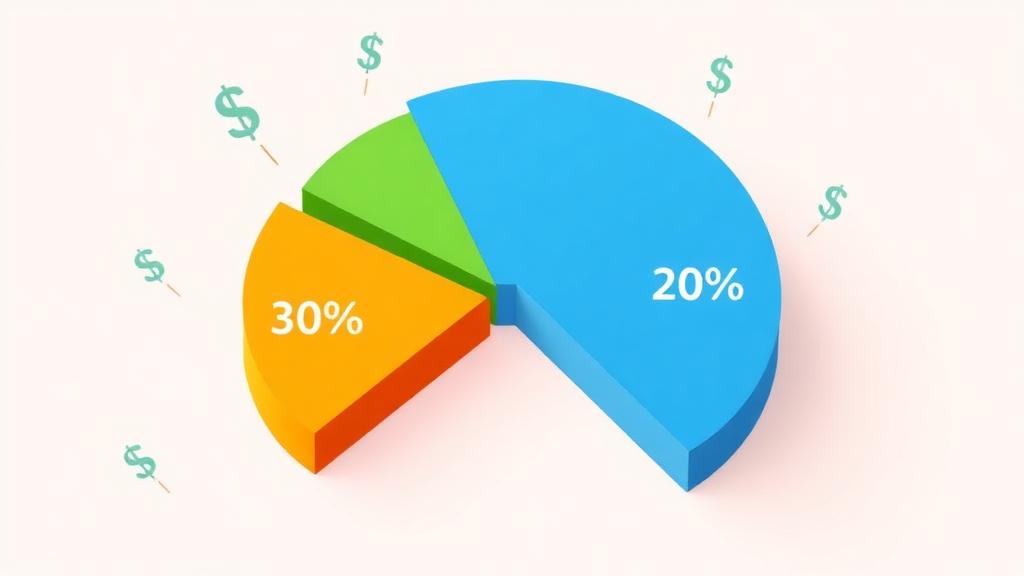
The 50/30/20 rule was popularized by Senator Elizabeth Warren in her book All Your Worth. The concept is beautifully simple:
- 50% of your after-tax income goes to needs (rent, groceries, insurance, minimum debt payments)
- 30% goes to wants (dining out, Netflix, hobbies, that oat milk latte habit)
- 20% goes to savings and extra debt payments (emergency fund, retirement, paying off credit cards faster)
That’s it. No complicated spreadsheets with 47 categories. No guilt about buying a coffee. Just three buckets.
Pro Tip: The rule uses your after-tax income—what actually hits your bank account. If you contribute to a 401(k) pre-tax, you can count that toward your 20% savings bucket since it’s technically coming from your gross pay.
The Real Numbers: 50/30/20 at Every Income Level
Here’s where most articles fail you—they explain the concept but don’t show you what it actually looks like with real numbers. Let me fix that.
| Monthly After-Tax Income | 50% Needs | 30% Wants | 20% Savings | Annual Savings |
|---|---|---|---|---|
| $2,500 (≈$30K salary) | $1,250 | $750 | $500 | $6,000 |
| $2,917 (≈$35K salary) | $1,458 | $875 | $583 | $7,000 |
| $3,500 (≈$42K salary) | $1,750 | $1,050 | $700 | $8,400 |
| $4,200 (≈$50K salary) | $2,100 | $1,260 | $840 | $10,080 |
| $5,000 (≈$60K salary) | $2,500 | $1,500 | $1,000 | $12,000 |
| $6,250 (≈$75K salary) | $3,125 | $1,875 | $1,250 | $15,000 |
| $7,083 (≈$85K salary) | $3,542 | $2,125 | $1,417 | $17,000 |
| $8,333 (≈$100K salary) | $4,167 | $2,500 | $1,667 | $20,000 |
Look at that annual savings column. Even at $35K per year, you’d save $7,000 annually if you stick to the 20%. That’s a fully-funded emergency fund in less than two years.
My Real-Life 50/30/20 Breakdown (Income: $4,200/month)
When I first applied this rule, here’s what my budget looked like:
The 50% — Needs ($2,100)
| Expense | Amount |
|---|---|
| Rent (1BR apartment) | $1,150 |
| Groceries | $320 |
| Car insurance | $145 |
| Gas | $120 |
| Phone bill | $65 |
| Health insurance (my portion) | $180 |
| Minimum student loan payment | $120 |
| Total | $2,100 |
The 30% — Wants ($1,260)
| Expense | Amount |
|---|---|
| Dining out / takeout | $300 |
| Entertainment (movies, concerts) | $150 |
| Gym membership | $45 |
| Streaming services | $35 |
| Clothing | $100 |
| Hobbies (photography gear) | $80 |
| Random fun stuff | $550 |
| Total | $1,260 |
The 20% — Savings & Debt ($840)
| Allocation | Amount |
|---|---|
| Emergency fund | $400 |
| Extra student loan payment | $200 |
| Roth IRA contribution | $240 |
| Total | $840 |
Here’s the thing nobody tells you: my budget didn’t look this clean on month one. It took about three months of adjusting before I nailed down realistic numbers. The first month, I massively underestimated my grocery spending and overestimated how little I’d eat out.
The 5 Biggest Mistakes People Make With the 50/30/20 Rule
After helping friends and family set this up (I became “the budget guy” at work, whether I wanted that title or not), I’ve seen the same mistakes over and over:
Mistake #1: Putting Wants in the Needs Category
This is the big one. Your $200/month gym membership isn’t a “need”—Planet Fitness at $15/month could cover your fitness needs. That extra $185 is a want. Same with your $75 phone plan when a $25 plan exists, or your premium Spotify when the free version works.
Be brutally honest: if you would literally survive without it, or a much cheaper alternative exists, it’s a want.
Mistake #2: Ignoring Irregular Expenses
Car registration ($250), holiday gifts ($500), annual subscriptions ($200)—these add up to $1,000+ per year that people “forget” to budget. Divide your annual irregular expenses by 12 and add them to the appropriate category.
In my case, irregular expenses added about $150/month that I wasn’t accounting for. Once I built this into my needs category, I stopped being “surprised” by expenses that happen every single year.
Mistake #3: Not Adjusting for High-Cost-of-Living Areas
If you live in San Francisco, New York, or Boston, your rent alone might eat 40% of your income. The rule needs modification. I’d suggest a 60/20/20 split or even 70/20/10 temporarily while you work on increasing income. The point is to have a system, not to stress about hitting exact percentages.
Mistake #4: Counting Minimum Debt Payments as “Savings”
Your minimum student loan or car payment is a need—you’re contractually obligated to pay it. Only extra payments above the minimum count toward your 20% savings bucket.
Mistake #5: Giving Up After One Bad Month
Life happens. Your car breaks down. Your dog needs emergency surgery. You overspend at a friend’s wedding. One bad month doesn’t mean the system failed. I blew my budget spectacularly in month four (a friend’s destination wedding cost me $1,800 I hadn’t planned for). I just reset and kept going.
When the 50/30/20 Rule Doesn’t Work (And What to Do Instead)
Let’s be honest—this rule doesn’t fit everyone. Here are situations where you’ll need to modify it:
If your needs exceed 50%: This is common for people earning under $40K in expensive cities. Consider the 70/20/10 split temporarily, or look into ways to reduce living expenses or increase income with side hustles.
If you have aggressive debt: Someone with $30,000 in credit card debt at 24% APR should probably flip to a 50/20/30 split—where 30% goes to debt payoff and 20% covers wants. Check out our guide on the debt snowball vs. avalanche methods for the fastest payoff strategy.
If you’re a high earner: Making $150K+? You probably don’t need 30% on wants ($3,750/month in fun money seems excessive). Consider a 50/20/30 where 30% goes to savings/investing. Your future self will thank you.
If you’re saving for a specific goal: Trying to save $1,000 in 30 days? Temporarily shift to 50/10/40 and sacrifice wants for a month. Short-term pain for long-term gain.
How I Modified the Rule to Save $14,000 in Year One
Here’s my honest confession: I didn’t stick to a pure 50/30/20 split. After three months of getting comfortable, I shifted to what I call the 50/25/25 split—I pulled 5% from wants and added it to savings.
That extra 5% on my $4,200 income was $210/month, which became $2,520 extra per year. Here’s how it broke down:
- Standard 20% savings: $840 × 12 = $10,080
- Extra 5% savings: $210 × 12 = $2,520
- Tax refund I saved instead of spending: $1,400
- Total: $14,000
The key wasn’t deprivation—I still had $1,050/month for fun. That’s plenty for dinners out, concerts, and my photography hobby. I just stopped buying things I didn’t actually care about to impress people I didn’t actually like.
Setting Up Your 50/30/20 Budget: Step-by-Step
Step 1: Calculate Your True After-Tax Income
Pull up your last two pay stubs. Look at the “net pay” line—that’s your after-tax income. If you’re freelance or have variable income, average the last 3 months.
Don’t include:
- Overtime you’re not guaranteed
- Bonuses (budget those separately when they arrive)
- Side hustle income that’s inconsistent
Step 2: List Every Fixed Need
Go through 3 months of bank statements. Tag everything that’s truly a need. Be honest—cable TV is not a need in 2026 when free options exist.
Step 3: Track Wants for One Month
Before setting a wants budget, track what you actually spend for 30 days. You might be shocked. I was spending $47/month on apps I’d forgotten I subscribed to. One of the best free budgeting apps can make this effortless.
Step 4: Automate the 20%
The single best thing I did: set up an automatic transfer of $840 to my savings account on payday. If the money never hits your checking account, you can’t spend it. I split it between my high-yield savings account and my Roth IRA.
Step 5: Review Monthly, Adjust Quarterly
Spend 15 minutes at the end of each month reviewing. Did you stay within each bucket? Where did you slip? Adjust the specific allocations within each bucket quarterly, but try to maintain the overall percentages.
Pro Tips From 3 Years of Using This System
Pro Tip #1: Create a “fun fund” within your 30% wants category. I put $100/month into a separate account that I use for impulse purchases guilt-free. If I want a $300 gadget, I wait three months. Often by then, I don’t want it anymore.
Pro Tip #2: Use the “24-hour rule” for any want purchase over $50. Sleep on it. I’d estimate this saves me $200/month in stuff I thought I wanted in the moment.
Pro Tip #3: When you get a raise, don’t increase your lifestyle. Put 100% of the raise increase into your savings bucket for at least 6 months. I got a $3,600/year raise in year two and saved every penny of it.
Pro Tip #4: Round up your savings. If the math says save $840, round to $900. That extra $60/month is $720/year you’ll barely notice missing from your wants category.
The 50/30/20 Rule vs. Other Budgeting Methods
| Method | Complexity | Best For | Weakness |
|---|---|---|---|
| 50/30/20 Rule | Low | Beginners, most people | Too rigid for very low/high incomes |
| Zero-Based Budget | High | Detail-oriented planners | Time-consuming, can feel restrictive |
| Envelope System | Medium | Overspenders, cash-preferred | Impractical for online purchases |
| Pay Yourself First | Low | Savers who hate tracking | No guidance on spending categories |
| 80/20 Rule | Very Low | People who hate budgeting | Lacks structure for needs vs wants |
In my experience, the 50/30/20 rule hits the sweet spot between structure and flexibility. You have clear guardrails without micromanaging every dollar.
Real Example: How a Couple Making $7,500/Month Uses 50/30/20
My friends Jake and Maria (names changed) take home $7,500 combined after taxes. Here’s their breakdown:
Needs (50% = $3,750):
- Mortgage: $1,800
- Groceries (family of 3): $650
- Car payments (2 cars): $550
- Insurance (health, auto, home): $450
- Utilities: $200
- Childcare: $100 (partial, family helps)
Wants (30% = $2,250):
- Dining out: $400
- Family entertainment: $200
- Gym: $80
- Streaming/subscriptions: $65
- Kids activities: $150
- Travel fund: $400
- Date nights: $200
- Misc fun: $755
Savings (20% = $1,500):
- 401(k) contributions (already deducted): counted separately
- Extra mortgage payment: $500
- Kids’ 529 plans: $400
- Emergency fund: $300
- Vacation sinking fund: $300
They’ve been doing this for two years and have built a $22,000 emergency fund, paid $12,000 extra on their mortgage, and saved $9,600 for their kids’ education. Not bad for “just” following a simple rule.
What To Do When You’re Over Budget
It happens to everyone. Here’s my triage system:
- Over by $50 or less: Absorb it. Don’t stress. Adjust next month.
- Over by $50-200: Identify the cause. One-time event? Ignore it. Recurring? Adjust the category.
- Over by $200+: Something systematic is wrong. You either have a needs creep problem or you’re kidding yourself about wants vs. needs. Time for a full budget audit.
The worst thing you can do is beat yourself up and quit. I went over budget 4 out of my first 6 months. The system still worked because the trend was right even when individual months weren’t perfect.
Frequently Asked Questions
Does the 50/30/20 rule include taxes?
No—the rule applies to your after-tax (net) income. Use the amount on your paycheck that actually hits your bank account. However, if you contribute to a pre-tax 401(k), you can count that toward your 20% savings since it comes from your gross income before it ever reaches you.
What if my rent alone is more than 50% of my income?
This is more common than people admit, especially in cities like NYC, SF, or LA. You have three options: (1) modify the rule to 60/20/20 or 70/20/10 temporarily, (2) find ways to increase income through side hustles or career moves, or (3) reduce housing costs through roommates, relocating, or negotiating rent. Don’t just give up on budgeting because the exact percentages don’t fit—adapt them.
Should I include my partner’s income in the 50/30/20 calculation?
If you share expenses, yes—combine your after-tax incomes and budget from the total. If you keep finances separate, each person should run their own 50/30/20 calculation and split shared expenses proportionally. My recommendation: at minimum, combine for shared needs (rent, utilities, groceries) and keep individual wants budgets separate. It reduces arguments significantly.
How long does it take for the 50/30/20 rule to show results?
You’ll feel a difference in month one just from the awareness. By month three, you’ll have a rhythm. By month six, your savings account will look noticeably different. I had $800 saved when I started; by month six, I had $5,800. The compounding effect of consistent behavior is powerful, even without compound interest.
Is the 50/30/20 rule outdated in 2026 with inflation?
The percentages might need adjusting (some financial advisors now suggest 60/20/20 given housing costs), but the principle is timeless: categorize your spending into needs, wants, and savings, then set boundaries. The specific percentages are starting points—customize them to your situation after following the standard split for 2-3 months.
Your Next Step: Start This Weekend
Here’s what I want you to do in the next 48 hours:
- Pull up your last bank statement and highlight every transaction in three colors: needs, wants, savings
- Calculate your percentages — most people are shocked to find they’re at something like 65/30/5
- Set up one automatic transfer to savings for this Friday’s paycheck—even if it’s just $50 to start
- Download a free budgeting app to track going forward (check our best free budgeting apps guide)
You don’t need to be perfect. You just need to start. The 50/30/20 rule gave me my financial life back, and I genuinely believe it can do the same for you. Three years later, I have a six-month emergency fund, zero credit card debt, and I still eat out twice a week.
That’s not deprivation. That’s freedom.